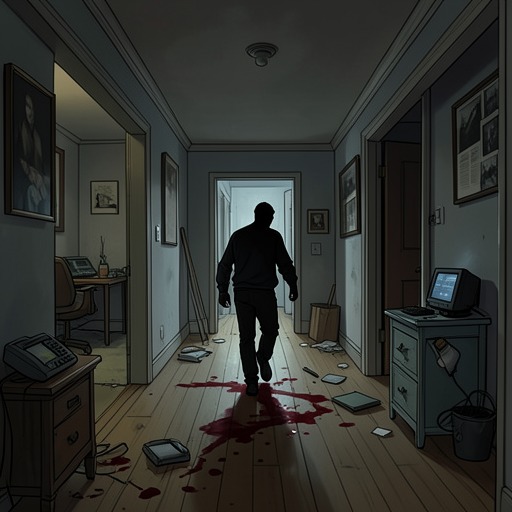
El Cuco’s transformation and hibernation cycle
The Outsider (Stephen King Edition)El Cuco’s transformation and hibernation cycle governs how the creature changes identity, rests, and relocates. Holly Gibney’s account links its usual months-long stillness to a gradual transformation, while the disrupted cycle in the present case explains its premature move, weakened condition, and incomplete resemblance to Claude Bolton. It also frames the investigators’ discovery of where it is hiding as a consequence of its need to rest near particular places associated with the identity it is acquiring or leaving.
The Usual Cycle
Holly describes a creature that ordinarily remains in one place for months after killing while its transformation takes place. It moves on only when the change is complete, or close to complete. The sequence is therefore not an instantaneous disguise: transformation takes time, and hibernation is part of the interval in which that change proceeds.
In Holly’s reconstruction, the creature’s resting place is connected to the person whose form it is taking or abandoning. She believes it hibernates in or near places of the dead, preferably places associated with that person’s bloodline. The Marysville Hole matters to her investigation because Claude Bolton’s uncle and cousins are buried there; Holly sees that family connection as a reason the site could serve as El Cuco’s refuge while it changes toward Claude’s appearance. This is presented as her theory, developed from what she has read and learned in Ohio, rather than as a rule independently demonstrated in the encounter.
A Cycle Disrupted
The pattern has been disturbed by events in Flint City. After a boy discovered El Cuco staying in a barn, it anticipated that police would come and had to flee before its ordinary period of staying in one place was over. Holly believes it moved south early to remain near Claude, and that the Marysville Hole then offered a suitable hiding place. The creature’s move is thus not described as the completion of a normal cycle but as a forced response to exposure.
That early relocation carries a cost. Holly judges El Cuco weak because it has been exerting itself when it should be hibernating. She attributes some of that effort to projecting appearances: the visions seen by Grace Maitland and Jeanette Anderson, she argues, were projections rather than full bodily appearances. In her account, a small part of the creature’s physical self was present during those manifestations. That would account for traces in the Anderson living room and for its ability to move a chair and switch on the stove light, while leaving no impressions on the new carpet. The projections therefore have limits, and using them drains a creature that should have been resting.
Holly distinguishes these partial manifestations from the one occasion on which she believes El Cuco appeared wholly in the flesh: the courthouse, on the day Terry Maitland was shot. She thinks it came there because it was hungry and expected many people to feed on. In retrospect, that appearance also exposed it to television cameras and helped create the trail by which the investigators began to find it. The cycle’s disruption therefore has consequences beyond physical exhaustion: hunger and overconfidence draw the creature into circumstances that make concealment harder.
The Incomplete Change
When Ralph Anderson reaches El Cuco in the Marysville Hole, its current transformation is visible in an unsettled face. It resembles Claude Bolton, but the resemblance is not yet complete: the chin and jaw differ from Claude’s, the face is asymmetrical, and its hair includes reddish-brown streaks. One eye is brown like Claude’s; the other is blue. Ralph recognizes the blue eye as the one he saw when Terry Maitland died, connecting the creature’s present appearance to the form it is leaving behind.
Ralph tells the creature that it is still changing: a projection Jeanette saw may have looked exactly like Claude, but the real body has not caught up. This contrast clarifies the difference between projected appearance and physical transformation. A projection can present an apparently finished likeness even while the body remains unfinished. The encounter gives Ralph concrete evidence for the process Holly has described, although the creature’s two-toned appearance also makes its incomplete state legible without reducing it to a simple disguise.
Exhaustion and Exposure
El Cuco itself says its condition is specific to its transformative state. It describes a touch during that period as a form of natural protection, usually not fatal, though Jack Hoskins was unusually susceptible. It also says that after touching someone it can often enter that person’s mind, or the minds of loved ones, and that it did this to members of Frank Peterson’s family, nudging them in directions they were already inclined to take. These abilities are disclosed during the confrontation as effects associated with the creature’s state and contact; they do not erase the cycle’s central constraint that transformation and relocation have left it tired.
The creature admits that it had to make the drive south too soon and buy supplies, both of which drained it further. Too tired to relocate, it tells Ralph that they are at a standoff. Its predicament shows how disrupted timing turns the cycle into a practical vulnerability: the creature has reached a refuge linked to Claude, but it cannot simply leave when the investigators find it. The hibernation period that would ordinarily conceal and sustain transformation has instead been compromised by flight, projection, and the effort of reaching its new hiding place.
Narrative Significance
The cycle makes El Cuco’s transformation a process with duration, location, and cost rather than an unlimited power to assume identities at will. Its need to remain near a resting place, its preference for sites linked to a bloodline, and the strain of projecting while it should be hibernating give Holly a way to infer where it may be found. Each condition becomes useful because the creature has departed from its ordinary pattern: the barn discovery forces it to move, and its activity brings it to the Marysville Hole before it is ready.
The encounter also turns an abstract theory into a visible contradiction. Jeanette’s projection can look like Claude, yet the physical creature retains features of Terry; the apparent likeness is ahead of the body’s change. Ralph’s recognition of the blue eye makes the transition personal as well as forensic, linking the unfinished Claude-like face to Terry’s death. Through that incomplete face and the creature’s admitted exhaustion, the cycle explains both how El Cuco has persisted across identities and why, at this point, it can no longer move unseen with its usual security.